Thursday, February 11, 2016

5 Reasons to Review with List Group Label


5 Reasons to Review with List Group Label

by Stephanie's History Store


When I was introduced to list-group-label in my education classes, I mentally scoffed at it.  I didn’t see the value in it, I thought it was painlessly simplistic, and that it couldn’t possibly offer any real value to students.  Well, I officially take all that back.  I’ve used it a few times every semester with my high schoolers and very recently with my middle schoolers.
There is a lot of flexibility to this strategy but the basic premise is that your students create or are given a list of vocabulary terms related to the topic at hand (i.e. the Revolutionary War), then they group the words how they see fit (i.e. according to when during the Revolutionary War a term came up, or if it was a person/battle/document, etc.). Finally they label their lists with a term that summarizes the list, or connects each item in the list (i.e. early Revolutionary War, or Military Leaders, etc).  Ideally some great discussion and connections will come of this.
I have a mix of 5th-10th graders in my classroom right now so I recently did a slightly modified version of list-group-label.  I paired my kids up and gave them a list of the vocabulary terms we were going to review.  They organized the words into lists that made sense to them and we discussed each pairs’ thought process.  Then they grouped the terms in a way that they saw them connect and we then discussed the groupings.  I was pleasantly surprised that almost all the groupings were different (one group did theirs according to “degree of success” which I hadn’t even thought of myself!)  Lastly they labeled their lists and we had a concluding discussion.  Each time I use this strategy it makes students think outside the box a bit and they always surprise me with the variety of perspectives they produce for this activity.

Over the years I have discovered 5 main reasons why I use L-G-L as a review technique and why I think teachers in any content area should give it a try.

1.  Vocabulary reinforcement–You and your students will be able to very clearly see if they know which terms are people/places/things/events/buildings/treaties/etc.  If you have time, you can even have each pair say or write a quick identification for each term to show that they remember something correct about them.  It’s one thing to know that Versailles and the Hagia Sophia are both buildings, but it’s a bit more to know where each is located and the purpose of each building, or to confirm if students remember the different significances between the Battle of El Alamein and the Battle of Midway.

2.  Pairs work–It is so important for students to have opportunities to work in pairs and groups.  In the real world people have to be able to cooperate and work with a variety of personalities.  Having them work with a different student each week helps students practice working with different personalities and different academic capabilities. They practice cooperating. They exercise some flexibility, and possibly even exert some patience.

3.  Form an opinion and defend it–I don’t tell my students how to group the terms, so not only will they have to form an opinion for themselves on how to make connections and group the terms, they have to defend it/explain it to the rest of the class.  Being able to explain your thought process is a skill that should be addressed in all content areas, and this is a low pressure way to have kids do just that.

4.  Make connections between different parts of the unit–We might not have spoken about Magellan and the Aztecs in the same class period, but could there be a connection between them?  That’s up to the students to determine.  Or, they might see a connection between Tuskegee Airmen and Navajo Code Talkers beyond both being soldiers from minority races during WW2. They should be encouraged to make those connections.

5.  Respect other people’s opinions and see that there’s more than one way to think–Not every pair will group up the terms the same way, and that’s OK!!!  It is so important for kids to learn (and to practice) the art of respecting a different opinion, especially if it’s an opinion you disagree with.  If the terms have been grouped differently across the pairs, that’s a great discussion opportunity for students to hear, and respect, the thought process of their peers.

As a bonus reason for using this as a review strategy, you will see growth in your students as the year progresses.  Students will think differently and defend their opinions differently based on the material and how they feel about it. As students become more comfortable with this activity they begin thinking more deeply (especially with making connections between parts of the material).  The deeper they think, the greater their ability to have organized, controlled, longer debates and to discuss their different thought processes.
If you’ve been on the fence about using list-group-label, go for it then let me know how it goes!!!

Thursday, January 28, 2016

CLASS December/January Freebies

A freebie from History and Psychology Resources. Grades 9-12    
This sanity-saving freebie  will help you organize and write letters of recommendation for students.


A freebie from 2Lifelong Teachers  Grades 5-8
This freebie includes 8 worksheets to introduce Greek and Latin Roots and Prefixes to your middle school students.  

A freebie from Secondary Supplements   Grades 6-8

You don’t want your students sitting all period taking notes. Because what are they really getting out of copy, copy, copy? Create engaging presentations with the simple addition of partner breaks. Your students will appreciate the movement and socialization.


https://www.teacherspayteachers.com/Product/World-War-II-Freebie-2007920A freebie from History in Focus    Grades 6-11

These sample pages from my World War II Bundle provide an example of the visually engaging worksheets contained in the full set that covers every major area of that historical event.


https://www.teacherspayteachers.com/Product/Colonial-Headlines-Review-Activity-2043308A freebie from Creative Instruction    Grades 10-12


Need an easy way to review colonial history with your advanced United States History classes? This fill-in-the-blank activity covers the key descriptors and events of the Thirteen Colonies (plus the Lost Colony) and as a bonus, asks students to make up some headlines as their own. Great for Advanced Placement United States History (APUSH) students. 


A freebie from Connie    Grades 6-12
The whole objective of this FREE activity is for students to have fun showing their understanding of the elements of literature while teachers retain their sanity during this month of emotional highs and lows.


A freebie from mELTing Teacher    Grades 6-12

Nouns, and verbs, and exclamations. Oh my! Parts of speech lessons get a bad rap for being boring. Your students will have fun practicing and using parts of speech with this Do-It-Yourself  poem. 


A freebie from Teacher in the Rye    Grades 9-12
It's not enough to just have students identify symbols while reading. Using these activities, your students will be able to analyze meaning, as well as go more in-depth when discussing both universal and contextual applications of symbols in literature. St


https://www.teacherspayteachers.com/Product/Review-Activity-for-any-Social-Studies-Topic-1850955


 A freebie from Stephanie's History Store   Grades 8-12
This review activity can be used for any history unit or social studies topic. Students write the news headlines and previews of a story related to the topic, then complete two other tasks. The instructions and rubric contain the expectations of the assignment for your students.


https://www.teacherspayteachers.com/Product/Complete-Guide-to-a-Successful-Poetry-Slam-ELA-7-12-1880242


 A freebie from Spark Creativity     Grades 7-12

This packet contains everything you need to put together a successful poetry slam, including an educator's breakdown for the five day unit, all relevant student handouts, and photos of student poetry slams and poetry slam programs. After helping students put together more than fifteen poetry slams both in the United States and abroad, my curriculum has come together into a solid unit that has produced fantastic results for me year after year.

Tuesday, January 12, 2016

Tech Talk for Teachers: Smithsonian Learning Lab


by: Rachel Cummings with Kate Harris


 If you haven’t visited the Smithsonian Museums lately, they are worth a trip. Not a trip in your car, or by plane, but a trip online, to the voluminous online resources available to teachers and students. Smithsonian Education features a slew, yes, a slew, of resources. There are lesson plans for language arts, history and culture, art and design, and science and technology.  You can download activity sheets for everything from pop-culture and traveling in the United States to the Apollo 11 mission to the moon or giant squid. Have students complete an interactive exploration of a topic—Rationing during WW1, Prehistoric Climate Change, an Overview of the Presidents…—at the IdeaLab. But, head’s up, Smithsonian Education is being replaced by a new site and a new approach to online education called the Smithsonian Institute Learning Lab.

The Learning Lab, which debuted in October, will become the mothership for the Smithsonian Institute’s online education resources, eventually replacing many of the existing Smithsonian websites. It offers users the breadth of the Smithsonian collection, and the ability to customize collections and add content of their own. For example, you can create unique collections from the Smithsonian holdings, upload documents, and attach notes and questions to an image.

Let’s see how.

To start, Sign Up on the homepage for an account. Having an account is necessary to create your own collections, and free. Log-in and then use the search bar in the upper left to search for Smithsonian holdings on the topic that interests you. Let’s try ‘revolution’ as an example. 2,190 resources match that search term. When you find one that you’d like to add to a collection, hover over it. Three icons appear. Click on the pages icon on the far right. Then, create a new collection (or, later, add to an existing collection.) When you have more collections, be sure to select which collection to add a piece to and be sure to click the ‘Add’ button in the upper right corner.

You can do cool things once you have a collection. Click on the sunburst in the upper right corner and choose Collections, then click on a collection to discover the possibilities. Use the rocket icon to make your collection public on the Smithsonian site. Create an assignment (file icon) to accompany a collection. Click on the pencil to open the editing tool; click the + icon in the left margin to add notes or design quiz questions for each image from a drop-down menu.

You can also peruse others’ collections. If you want to see what’s out there, don’t put anything in the search box on the homepage, but hit the enter key. It pulls up over a million resources. Narrow this down by selecting the Learning Lab tab on the left, under the search box. Now you can scroll through the 145 public Learning Lab collections. Hover over each to see the title and the creator. If you find one you like, click on it to open it. If you want to edit it, use the icons in the upper right corner to copy the collection. This adds the collection to your own collection and you can now edit and add to it as you like. Cool, huh? And useful. Thanks to the Smithsonian Learning Lab, you can now take your students on a customized tour of all that our nation’s greatest museum has to offer.

If you like this idea, you might also like:
https://www.teacherspayteachers.com/Product/Abraham-Lincoln-in-the-1850s-from-Kansas-Nebraska-to-his-election-2123506https://www.teacherspayteachers.com/Product/Colonial-Headlines-Review-Activity-2043308 

Sunday, January 3, 2016

Diving Deeper into Symbolism


bNoelle Franzen

TpT Store: Teacher in the Rye


You’ve taught your students about symbolism. Let’s say you’ve discussed how the apple in The Giver that changes color only for Jonas might symbolize how different he is than the rest of his family and the people around him. But, what next? Students can say they “get” how the apple is not just an apple, but is there a way to guide them into a deeper connection between the symbolism of the apple and a theme? Maybe Jonas is different because he represents a catalyst for change in an unchanging world. As a teacher, you want to make sure they make those deeper connections.

The Set-up:
I’ve thought about this often; I teach high school freshmen and, with each new group that comes into my classroom, I hope that they have held onto a little of what they learned in middle school. I like to bring up symbolism with my students early in the year. Mostly, it’s a refresher, and we spend about a week throwing around ideas in our warm-ups every day, and then there’s a quiz on what we’ve covered that week.

The Follow-Through:
We then work with symbolism as an isolated lesson where they must find “meaning” within a seemingly unconnected pair: abstract noun and concrete noun. For example, how could a picture frame possibly symbolize disappointment? They figure it out—often with hilarious or sorrowful results. Once, while doing this exercise with an honors class, a boy who just had a crush break his heart wrote about the pain of disappointment in an image that was framed to freeze a perfect moment of happiness. It was strikingly poignant.

After we’ve read a short story, we isolate some symbols and discuss whether or not those objects or people mean anything more than themselves. At this point, I expect them to understand that symbolism is more than its object, but when we read I don’t necessarily want them to be reading to look for objects that might be symbolic of something greater. I hope that they sense meaning first, and then have the lightbulb moment of, “Oh, there’s the connection!”

Extension:
Now we’ve moved on to another reading selection. This time, they need to make a connection between symbols and themes. How could, say, the symbol of the island in the Richard Connell’s short story The Most Dangerous Game connect with the theme of man trying to rule alone, with no laws and no accountability?
When we read our first class novel, we are ready to take symbolism to a new level. Students should not only be able to identify symbols and what they stand for, they also should be able to articulate in writing and in collaborative group discussions how symbols might add to the development of a specific character. This sounds easier than it is for many students. I like to think with practice, and with a little thought, all students can work toward mastering this understanding. What I’m really going for here is that students use different cognitive processes to approach a concept. This symbolism process, if you will, has taken me a while to develop, and it was only a couple of months ago that I was finally able to incorporate this piece of connecting symbols with characters into an activity.

How Diving Deeper into Symbolism (DDS) works:
Step 1: Students have read ¾ of the novel, are familiar with the characters, understand what symbolism is, and are able to recognize the novel’s symbols. If you want to use this with a short story, read the whole text—maybe twice. I am using it with John Steinbeck’s The Pearl, which is full of symbols and perfect for inspecting closely.
Step 2: Students also should complete the Symbolism Level One chart (included in DDS), either on their own or however you’d like to arrange them in class. It also could be finished as homework, but I don’t recommend flat-out assigning it for homework. This portion of the lesson helps students identify and interpret symbols in the text and provide textual examples for each.
Step 3: Have students complete the Quick Write, which is included in DDS, preferably at the beginning of class. This is usually about a 10-minute activity. It directs students to reflect on something they found interesting in the text, two symbols, and three connections to the theme. The quick write serves two purposes: students have something to bring to the group, and you have something to assess students’ understanding.
Step 4: Have students assemble into groups (assigned or random) to complete the Symbolism Level Two worksheet. Provide each group with at least a couple copies of the Universal Symbol Chart for reference. You will have to assign a character to each group. Provide a double-sided copy of the Symbolism Level Two handout if you choose to give each group two characters to focus on. I’d start with one since this may be a new approach for them.

Before they start, give them as much focus as you choose. You may want to point them toward a category from the Universal Symbol Chart. Perhaps what you’re reading lends itself to focusing on one topic more than another. Or, you may require that they look for evidence of all four (colors, seasons, animals, nature). You may want to complete a sample or let them figure it out as a group. Circulate to observe the process.
About 7-8 minutes before the Level Two phase is over, I like to hand out the Group Response Sheet, as it will provide the group an opportunity to synthesize what they’ve discussed and turn that into a single, agreed-upon connection. It will also help them address any clarification issues they are having with the text. You also could wait unit the next day for this. The Group Response Sheets will provide you with starter questions for a whole class discussion.

I love working with my students on this material, seeing what they write, how they think, and listening to the discussions they have with their peers. I hope that this process gives you a framework for diving deeper into symbolism with your students, and that it gives students not only the opportunity to discover meaning in a work of literature, but a rich, new way to approach thinking about a single concept.

Sunday, December 20, 2015

Here's an Idea: Vision Boards

by Catch the Buzz TpT Store: Catch the Buzz
Catch the Buzz

January is a great time for students create vision boards! Some people call them "dream boards," or "goal boards," but I like to call them vision boards because the creators of the boards are really projecting a VISION of their future.
      Catch the Buzz                               Catch the Buzz
I explain to my students that a vision board is a collage of pictures, phrases, and words that represents what they want to be, do, or have in their lives. Creating a visual representation of their future selves can inspire them to take the steps necessary to achieve their goals.

For their vision board to be effective, I tell students to hang their board in a place at home where they will see it every day. Visualizing and believing in a positive future are the first steps to creating the life they dream of. Hopefully, this will then inspire them to consider what they need to do to achieve their goals and to take the steps that will lead to their goal.

Vision boards are a great way to start off the New Year and as an added bonus, you'll learn a lot about your students!

Sunday, December 13, 2015

A Winter Holiday Jingle

http://teachitwrite.blogspot.com/2015/12/a-winter-tinglyjingly-jam-for-my.html


http://teachitwrite.blogspot.com/2015/12/a-winter-tinglyjingly-jam-for-my.htmlIn our December issue, Connie Casserly wrote an awesome A Teacher's Winter Holiday Jingle to the tune of White Christmas. She's put it up on her blog for you to read and you've got to go check it out! If you like it, leave her a comment to let her know!

Sunday, November 29, 2015

Free Downloads for your Secondary Classroom


https://www.teacherspayteachers.com/Product/How-to-Write-a-Paragraph-Constructed-Response-Writing-Formula-RACE-Mnemonic-328768A freebie from Julie Faulkner                       Grades 6-12

RACE takes a writer from the beginning of a paragraph to the end. Therefore, it can be expanded to an entire essay. Using a brain-based strategy such as this one frequently will produce so much growth and improvement in writing fluency.


https://www.teacherspayteachers.com/Product/Graphic-organizers-3-FREE-organizers-for-newspaper-article-writing-1826371 

A freebie from Doc Running             Grades 6-12

Newspaper projects can be a valuable way for students to learn about a subject or assess what they know, but they can be tough.  These graphic organizers will help students visually gather their information and write their articles. 


https://www.teacherspayteachers.com/Product/Super-Football-Game-Longitude-Latitude-Scavenger-Hunt-Activity-1029850

A freebie from Michele Luck                Grades 5-12

Allow your students to practice their longitude and latitude skills while having fun with this Super Bowl Scavenger Hunt Handout. Students can work individually or in small teams to trace the coordinates, locate the teams, and identify the NFL stadiums.

https://www.teacherspayteachers.com/Product/Pilgrims-and-Thanksgiving-Bingo-1512705 


A freebie from History Gal                Grades 6-12

See how much your students know about the Pilgrims and the origination of Thanksgiving with this free bingo game!


https://www.teacherspayteachers.com/Product/Denotation-and-Connotation-Activity-345325 


A freebie from AlwaysLearning          Grades 4-7

Understanding mood and tone is integral to gaining deeper meaning from text. The CCSS requires a realignment of a reading program as well as additional skills and strategies to better comprehend text. Understanding text at a deeper level requires readers to comprehend the connotation of words that an author uses to create mood and tone. This mini-lesson and activity defines the two and provides a large group of words for small groups or partners to sort into Neutral, Positive, or Negative groups. This activity can be done on chart paper or easily adapted to Interwrite boards.


https://www.teacherspayteachers.com/Product/Book-Club-Discussion-Organizer-959660 

A freebie from 2 Peas and a Dog  Grades 5-9

This product is a collection of 6 graphic organizers to help student engage, connect and think about their reading. Students are given lots of room to write their thoughts as they read their novels. Boxes are big enough for students to record their thinking on sticky notes and then collect them on the graphic organizer of their choice.

The organizer has six different reading strategies graphic organizers: plot, characters, connections, questions, predictions and a combination organizer for students to fill in before, during and after reading.


https://www.teacherspayteachers.com/Product/European-Middle-Ages-Vocabulary-Unit-1315884               

A freebie from Leah Cleary               Grades 6-12

This is the 4th complete vocabulary unit in my world history series. It serves as an organization tool and framework for a unit on the European Middle Ages. This method provides students with the consistency they need to reinforce vital content vocabulary concepts in an entertaining manner.


https://www.teacherspayteachers.com/Product/FREE-What-to-expect-for-the-ACT-English-breakdown-strategies-tips-1503586 


A freebie from Bridget Riggs         Grades 10-12

A breakdown of ACT Test Strategies, Question Types, & Section Timing
The ACT test is quickly becoming the most popular test taken for college entrance. Help your students know what to expect and how to study for the ELA section of the ACT.
This 29 page PDF file is a collection of information about the English section of the ACT test for students.


https://www.teacherspayteachers.com/Product/creARTive-writing-Quadrille-at-the-Moulin-Rouge-Henri-de-Toulouse-Lautrec-2118470 

A freebie from Writing by Rachel      Grades 6-12

Refresh your writing prompts with this freebie! creARTive writing is a unique way to integrate art and to inspire creative writing. Students will create an original writing using Henri de Toulouse Lautrec's painting Quadrille at the Moulin Rouge.


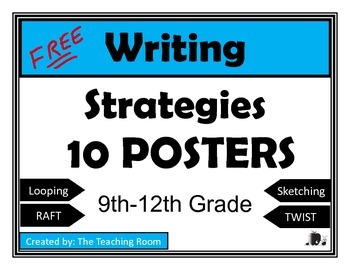
https://www.teacherspayteachers.com/Product/Writing-Strategies-Posters-High-School-1975149 


A freebie from The Teaching Room    Grades 9-12

10 Writing Strategies Posters (8.5 x 11 in).
Black and white, plain and practical.
Includes teacher notes with a purpose for each strategy.


https://www.teacherspayteachers.com/Product/Time-Management-Mini-Lesson-Prioritizing-from-Daily-Living-Skills-2033139

A freebie from Susan Traugh            Grades 9-12

"Prioritizing" is a free mini lesson from the Daily Living Skills series of workbooks featuring transition skills designed for mild-to-moderately affected special needs high school students, but appropriate for any young person wanting independent living skills.